here and there

Showing posts with label Borscht. Show all posts

Tuesday, December 8, 2015

Vushky, Mushroom Dumplings

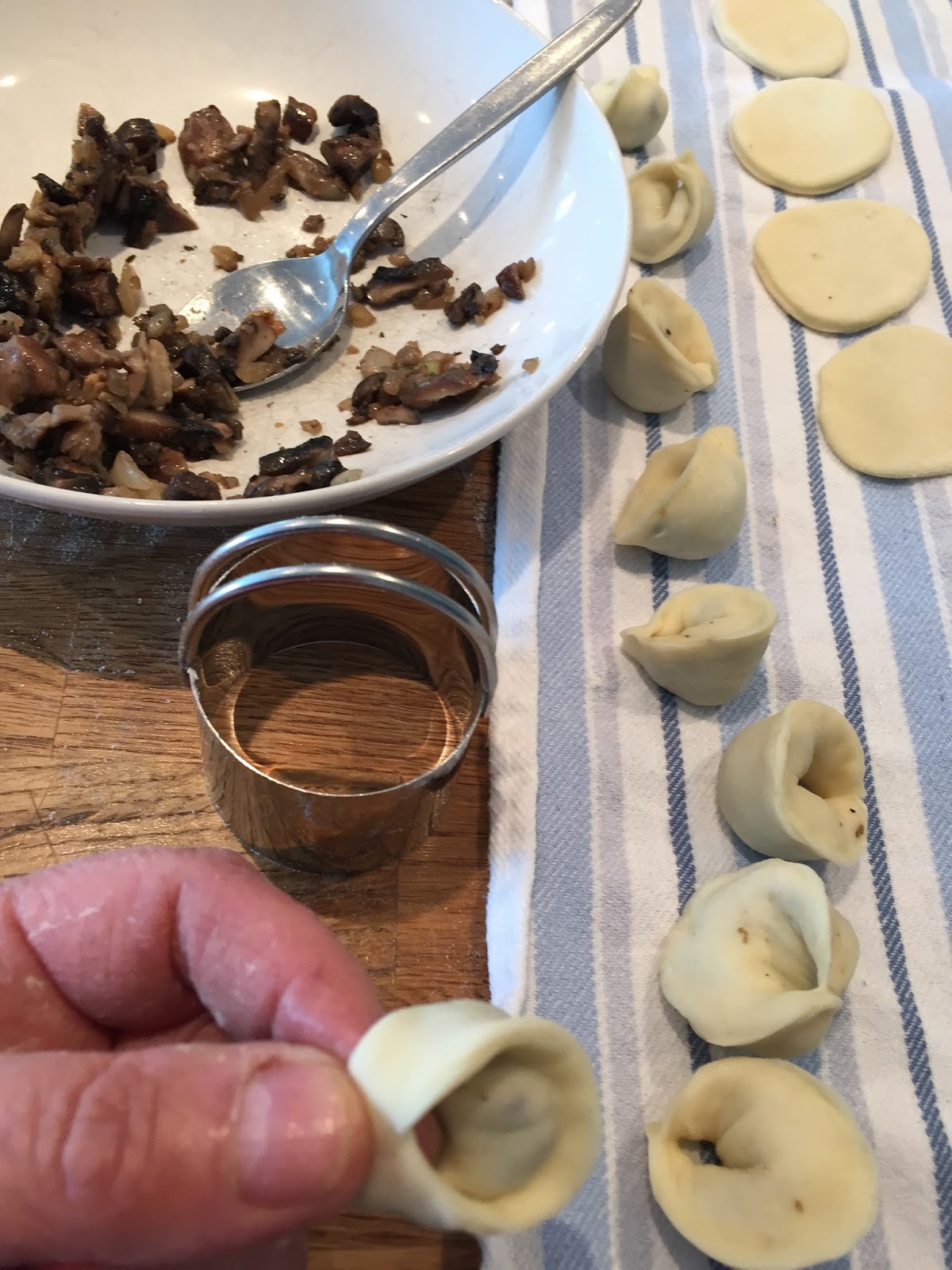
Vushky, "Little Ears"

These tiny dumplings are part of traditional Christmas Eve dishes and served in Lenten Borscht.  Vushky translates to "little ears' because of the dumplings final shape.   As a child, I remember being fascinated by these tiny white dumplings floated in a clear Borscht broth on Christmas Eve at my Grandmother's place.


Sauté mushroom and finely chopped mushrooms in drizzle of Olive Oil.  Wild Mushroom powder was added to mushrooms. 


Chop the cooked mushroom filling

Again, I used the same dough recipe I did for the Cottage cheese pyrohy the recipe for this dough is my Mom's recipe for Pyrohy.


I did do two different shape styles and will have to wait to see which one floats better in the broth. One style is to pinch the ends so you get a circle shape, like the Italian tortellini. For the other shape pinch the ends together over top of the dumpling.


Using a smaller cutter size or glass, I got 4 dozen of these tiny dumplings.

Friday, January 9, 2015

2015 Ukrainian Christmas Eve wrap up across Canada


As the winds howl and the temperature drops, Jan 6th is looked forward by many as a special day wrapped in tradition, family gatherings, spiritual and religious beliefs.

Traditions and spirituality are at the heart of Ukrainian Christmas and there is less of an emphasis on gift-giving than in a traditional North American Christmas celebration.

Preparation begins early for this feast, my Mom started this preparation a week before, where as I usually start much earlier by making and freezing Pyrohy and Holopchi's


For the last four years, we have been spending this time in Northern Manitoba and celebrate with my 92 year old aunt and her family.  The 12  traditional dishes were prepared for around twenty people by my aunt with the help of her sister and daughter in law for a couple of weeks before the celebration.

This year, with the holiday being in the middle of the week, we spent Ukrainian Christmas at home


My Brother who normally also attends the celebration at our Aunt's spent Ukrainian Christmas in Winnipeg at friends.
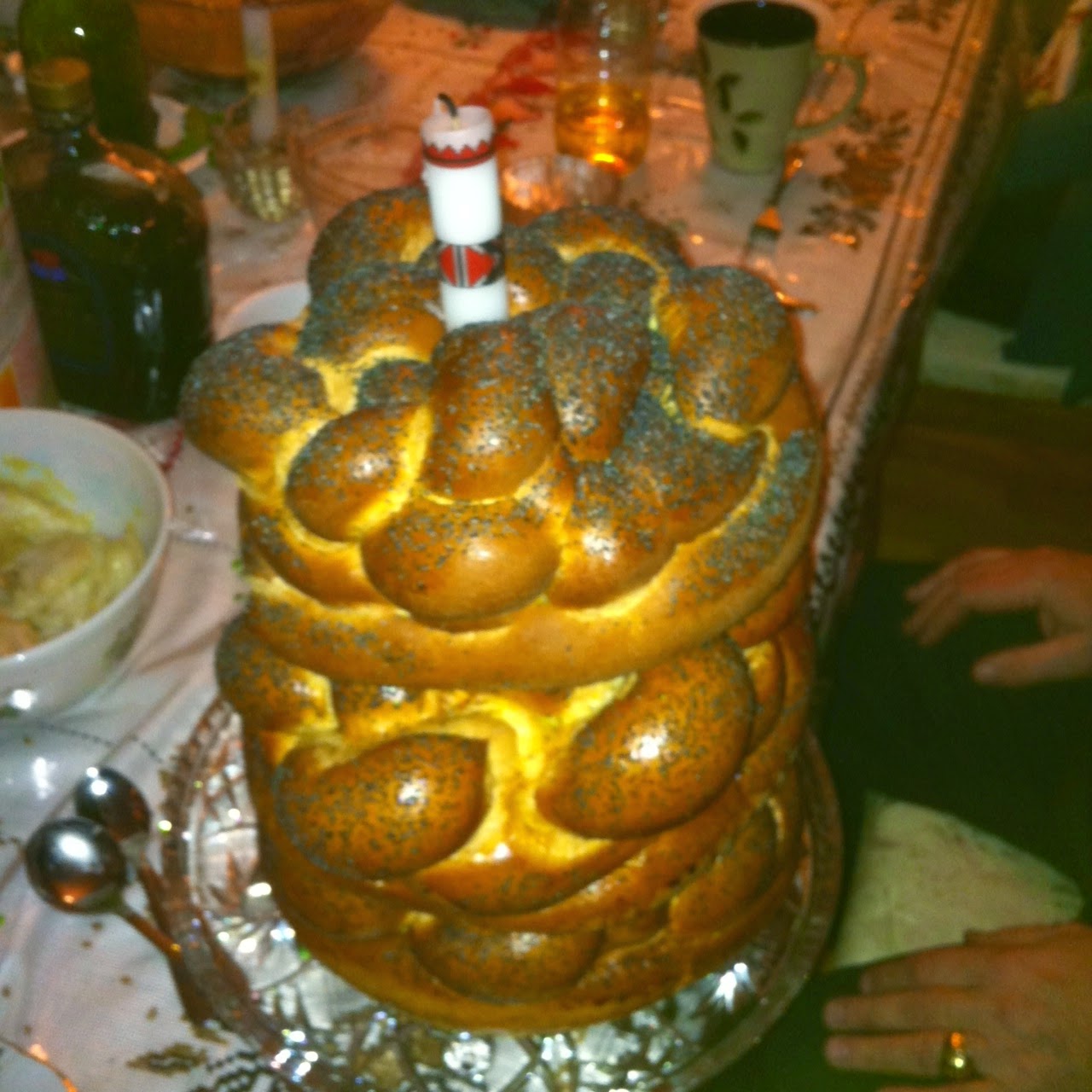
Kolach

Kolach


A small bale of hay was placed under the table to symbolize the manger.


Looking across Canada, here are some of the links I found about this celebration in other provinces

From Edmonton, 
Olesia Luciw-Andryjowycz, with the help of her sister-in-law Irene Miskiw, Luciw-Andryjowycz spent most of Tuesday preparing an elaborate vegetarian feast for Christmas Eve featuring kutya — cooked wheat with honey and poppy seeds — sauerkraut, cabbage rolls, pickled herring and other traditional dishes, brought out one by one. 


 Thirty two family members were welcomed into her home in North Edmonton, the smells of simmering red borscht and sounds of Ukrainian Christmas carols filled the room. 


Only when the first star was spotted in the sky did the family sit down and eat.


Two tables adorned with embroidered tablecloths, and garlic at each corner to ward off evil, were set side by side in the home to accommodate the large crowd and 12 traditional foods. 

Nearby the family is a sheaf of wheat, a reminder of the farmlands where the Ukrainian family came from.
Luciw-Andryjowycz’s parents were just one of the many families that move to Alberta from Ukraine in the late 1940s and 1950s. 

When the first star appears and the family sits down to eat, they share blessed leavened bread, wishing each other good health, prosperity and happiness. But for most, the turmoil in their homeland isn’t far from their minds. “We will say quite a few prayers for Ukraine this year,” Luciw-Andryjowycz said.


In Saskatoon, – A celebration rich with tradition is underway in homes throughout Saskatchewan.  Families gathered  to celebrate Ukranian Christmas Eve, according to the Julian calendar.
Pat Hawryliw’s grandparents moved from Ukraine to Saskatchewan 115 years ago.  Three generations later, the traditions of their homeland remain deeply rooted.  “It’s just a thing, engrained in you that you feel that you have to do,” said Hawryliw, seated at the kitchen table where a candle burns at the center of three loaves of bread, representing the Holy Trinity.
Christmas Eve afternoon, the head of the family will place a sheaf of wheat in a corner of the residence.  Traditionally it is placed under the table to symbolize the manger.  When the first star is spotted, a feast begins with a wheat grain pudding.
“That dish is called kutia and every meal starts with it and it is a symbol of Jesus and the last supper.”
Hawryliw has spent three days preparing food for Christmas Eve.  In total, 12 meatless dishes will be served signifying the end of fasting during 40 days of advent.  Borsht, cabbage rolls (holubtsi) and perogies (varenyky) are part of the meal along with several other dishes made from harvest grains, garden vegetables, and orchard fruits.
Focus on family and religion keeps the traditions strong, “We don’t have the commercialism involved in it as much.  It’s more of a spiritual thing. Gifts are not given out,” Hawryliw said.
In Regina
For Barb Dedi, the days of work that goes into preparing 30 dishes for a Ukrainian Christmas Eve feast is all worthwhile when she can share those traditions with people from around the world.


“We started back in the 70s first just with the family, but then about 20 years ago we started to open up our home to invite many different cultures including Chinese, Mexican, Sudanese, Caribbean, First Nations, Metis, Polish, German and Turkish, so they can experience Ukrainian Christmas,” she said.

Dedi prepares a total of 30 meatless dishes including 12 traditional dishes starting with kutia made of wheat and honey, plus borscht, nachinka (corn meal), stewed fruit, multiple kinds of cabbage rolls, garlic beans, sauerkraut, fish and pickled fish to name just a few.
 

Although Dedi didn’t grow up with traditional Ukrainian food as "My dad and his ancestors when they first came to Canada didn’t like being Ukrainian because there was a lot of discrimination against Ukrainian people.” 

 She was determined to learn all she could about the Ukrainian culture and other cultures from around the world. Her kids grew up immersed in Ukrainian cultural traditions including dance and language classes.


This year, Dedi’s daughter is also sharing with different cultures by making Ukrainian Christmas feast in Guatemala, just like she did when she spent four years in Kuwait.


This Christmas will be particularly significant for their family as they mark the passing of her ex-husband with a small table set in his honor as part of the tradition to set an extra place for those who have passed on. 

“The hay by the window is for good luck and it’s also to represent the animals – the animals on the farm would always get part of the meal,” she explained.  “Also we put a candle in the window to welcome the homeless.  At the front door when you come in there is salt to keep illnesses away and also garlic.”

Traditional bread called kolach sits on every table, but it cannot be eaten on Christmas Eve because it a symbol of Christ.


Some of the other traditions like throwing the wheat mixture on the ceiling and leaving all the leftovers out all night have lapsed a bit because they aren’t very practical, but Dedi does leave some dishes out all night.  But they do maintain the tradition of making sure every guest tastes every single dish – even those that aren’t too popular.
Ukrainian Christmas Eve. 
At 81 years old, Jenny Mysak still host the traditional Ukrainian Christmas Eve dinner for her family every year.
"I think it's a very nice tradition. My mother brought me up, and I try to maintain it for my daughters and my granddaughters and the family. It's a lot of work, but it's a beautiful tradition."
It takes Mysak two weeks to prepare enough pierogis and cabbage rolls, which are big favourites.
She gets help from her son-in-law, Greg Bedik, to handle the fish, as meat is not allowed at a nativity supper.
He prepares it by breading the fish in an egg yolk and milk batter, but "I don't fry it, we just bake it and it's one of the 12 traditional dishes that we make for the evening."

Mysak's family begins their meal with a prayer and then an entree of borscht soup.

Her granddaughter, Natalia Bedik, says she loves spending time with her family and finds
"Ukrainian Christmas is all about the traditions"


The most heartwarming story for me was from Vancouver Chinese seniors usually don’t eat a lot of perogies. But they got their chance on Tuesday at the Vancouver Second Mile Society, which served up a special Ukrainian Christmas lunch. “(The) food is good,” said Harry Lee, 78.
“I like this (cabbage roll), and this (kielbasa). Excellent. Thank very much whoever thought of this, thank them very much. Okay?”
The lunch was conceived by volunteer coordinator Judy Chartrand, who was looking to do something different at the Downtown Eastside seniors centre.


There are several turkey dinners in Vancouver’s poorest neighbourhood at Christmas. But Ukrainian Christmas is celebrated according to the old Julian calendar, which means Christmas Day is Jan. 7, not Dec. 25.
So she decided to throw this year’s Christmas dinner a couple of weeks later, when people might really need it. And to serve Ukrainian food, not turkey.
“Everybody’s kind of turkeyed out,” she reasons.
“So (serving) all the Ukrainian foods — the cabbage rolls, perogies, sausages and stuff — we thought would be a good thing.”
Ukrainians traditionally have a big meal on Christmas Eve, so at about 11:30 a.m. Chartrand and several volunteers started serving approximately 100 seniors. 


The food went down well with a table full of elderly Chinese ladies, who quickly devoured the meals served in Styrofoam containers.  But trying to interview them proved fruitless — they spoke little to no English.


James Pau explained there are typical of many Chinese seniors in Chinatown and the Downtown Eastside.
“Some think (all) Chinese people are rich,” said Pau, a volunteer for  four decades.
“Actually no, many are poor. Especially this group — they have very little or no education at all. They’re from Mainland China mostly, from the southern part.
“Now the Chinese (immigrants) come from the north, where they speak Mandarin, but this group is mainly from the south, where they speak Cantonese.”

In any event, Pau said it was easy to see why the ladies enjoyed the Ukrainian food.
“It’s similar to Chinese cooking,” he said. “Perogies are similar to Chinese dumplings.”

The Ukrainian Christmas festivities will wrap on Jan. 19, with the Feast of the Epiphany.

Borscht for Christmas Eve (pisnyy borscht) with dumplings (Vuška), take two


This is the simplest recipe going without any fancy ingredients but look at the beauty of this vibrant soup with the little white dumplings floating in the broth.

Fill a stock pot with water and start chopping! 

Julienned Carrots

Sautéed onions in Olive oil

Soften dried wild mushroom in warm water

Simmer Vegetables until cooked

Check out recipe for Borscht for Christmas Eve (pisnyy borscht) with dumplings (VuÅ¡ka) that I made on the 24th.


Yes, in this case the dumplings were boiled in water first and added to the cooked soup before serving.  Therefore they did not take on the dye of the beets if cooked in the borscht! 

Thursday, January 1, 2015

Cooking Soup!


Yes, it is January and it makes me think of Carole King's song Chicken Soup with Rice


In January it's so nice
While slipping on the sliding ice
To sip hot chicken soup with rice
Sipping once, sipping twice
Sipping chicken soup with rice


Rarely does an article one reads resonate so loudly as did the article about common mistakes one makes in cooking soup in Good Housekeeping.   I have included the tips from the article in blue.  My Mom loved making daily soups and one of my sons has fond memories of her soups.  Many of the points discussed by the article, I have discovered over the years and continue to learn.  Most recently was making Borscht for Christmas Eve. 

This year, I had decided to make my grandmother beet soup for Christmas Eve dinner, which was meatless and dairy less. I remember loving the looks of this soup as a kid as I liked the tiny dumplings called little ears floating on the broth.  

I picked a recipe that I felt was most authentic that she may have made for Christmas Eve.  I often wonder where her food was stored during this mammoth preparation of this meal as this was before electricity in her village, although she did have a root cellar and it was winter. 

The recipe used water, no measure just fill the pot and add the vegetables to the water.
Yes, I was skeptical as although I rarely if ever use a prepared broth, I do start my soup with simmering meat, pork, beef or chicken in water with aromatics.  I totally agree with the article that using broth may not give you the flavour you may want.  I often wonder what was used in making the particular broth and when did recipes start using prepared broths in them. My Mom never ever used prepared broths! 

However in preparing this beet soup, I was not sure how much flavour a few vegetables would give the broth, so I did caramelize the onions and added dried wild mushrooms that had been soften in warm water.  The recipe did not require this step.  I did keep tasting the broth and to my amazement, the flavour developed beautifully! 


 Ignoring water 
Think you can’t make a delicious soup because you don’t have broth? Just use water instead. Trust me on this one. In fact, you’re better off using water than an inferior broth. Before you dump in a can or container of broth, taste it. If you wouldn’t eat it as is, why would you want to add it your soup? You may even find you prefer soups made with water, which really let the ingredients shine. Just be aware that when you use water, it’s particularly important to add the right amount of salt. One of my personal tricks is to throw in a rind of Parmesan cheese to help flavor the soup as it simmers.

What is that expression "a watched kettle never boils"?  In this case, with my focusing on the flavour of this broth, I did add too much salt as the broth was a bit to salty as it cooked down, I should have added more water at the end.  Generally I do have to remember to add salt as I lived with a grandmother who was on a low salt diet, I still prefer food unsalted.  I like to use fresh herbs and seasoning instead. 

Not using enough salt 
Nothing is as crucial as seasoning correctly. Taste as you go. While you can use a recipe as a guideline, learn to trust your own tastebuds.

In making the Borscht, I did boil the water first and add the vegetables to this, but decreased the temperature immediately to simmer the vegetables.  The vegetables in broth were cooked until still firm but tender.  

Boiling instead of simmering
You want a small bubble or two to rise to the surface of the liquid every few seconds. More than that and your meat and vegetables will come out dry and overcooked.
As mentioned above, vegetables will dry out and overcook if boiled.  When I assemble, my Asian influenced chicken noodle soup, I usually cook the root vegetables in the broth, but add the leaf green parts of Baby Bok Choi, Shanghai Bok Choi or Spinach to the bowl chopped without cooking. The hot broth will cook the greens.


Overcooking the vegetables 
Let’s say you’re making white bean soup. Start by sautéing onions, garlic, maybe celery, then adding the water and beans, and simmering. Add the carrots in the last half hour or so or when the beans are close to tender. That way the carrots will come out cooked but not mushy. Ditto, for other veggies…add them according to how much time they need to cook.
Although, I did not add tomatoes to the recipe, Tomatoes also do turn acidic if cooked for a long time.  This is something you may find happens when making tomato sauce using fresh tomatoes, just add a bit of sugar. 

Adding tomatoes at the beginning 
The acid in tomatoes can keep beans and vegetables crunchy. Don’t add the tomatoes until the final 20 minutes when all of the other ingredients are close to tender.
In assembling Asian influenced chicken noodle soup; Fish sauce, Hoisin sauce, soya sauce chili garlic sauce and hot sauce are left for individuals to garnish their own soup! 


 Neglecting to garnish 
A handful of fresh herbs, freshly-ground pepper, a sprinkling of Parmesan cheese, and crunchy croutons add the finishing touches in terms of both flavor and texture. When I make lentil or split pea soup, I like to add a splash of balsamic vinegar or squirt of fresh lemon juice to each bowl to brighten the flavor. Other good last minute add-ins: a dollop of yogurt or sour cream, toasted pumpkin seeds, or a spoonful of pesto.
I have never used a pressure cooker, although my Mother in law did.  These pressure cookers terrify me.   I also can have a soup ready in an hour.   Filling a pot up with water, add aromatics such as herbs, chopped onions and chicken pieces, bring to boil, skim off the impurities that rise to the top and reduce the heat, let simmer until the chicken is cooked.  Add chopped vegetables and serve with noodles. 

Not trying a pressure cooker
If you’re afraid of using a pressure cooker, it’s time to get over it. With multiple safety features, today’s models are fail-proof. Why use one, you ask? When your hubby calls to tell you he’s coming down with a cold, if you pick up a chicken, you can have homemade soup on the table in under an hour.
There are two things that were not mentioned in this article in making soup. My Mom was very particular with the clarity of her broths.  I find that I still have difficulty eating a muddy looking soup. I do remember her straining the broth through cheese cloth to improve the clarity.


The other point that I have found is that Pasta added to the broth does cloud the broth or leftover noodles in the soup will absorb all the broth.   I usually add the cooked pasta to the bowl when assembling the soup.  For Hot Pots, I added a bowl of cooked noodles to the side for people to add to their broth. The leftover cooked noodle is stored separately from the broth. 

The article did not mention that a delicious soup can still be made using Vegetables in your crisper that look a little sad! 


Tuesday, December 30, 2014

Borscht for Christmas Eve (pisnyy borscht) with dumplings (Vuška)

This year for the first time, I made beet soup, Borscht for the Traditional Christmas Eve meal, not that I am a big fan of this soup but I have great memories around this soup. 


One is the memory of my Dad's sister coming from Thunder Bay to the farm during the summer and being woken up early to the clatter of pots and pans from the kitchen.  My aunt had been to the garden and picked fresh vegetables for this soup and was preparing the soup for lunch.  

I always marvelled at the colour of this soup garnished with fresh dill.  Rich farm cream had been added carefully to this soup when simmering to prevent it from curdling in the acidic broth as vinegar had also been added.

My husband loves this soup and had requested this as part of our wedding menu!  My son had my Mom's Borscht recipe made and served in shot glasses garnished with sour cream and fresh dill at his wedding reception as an aperitif.

My Mom's soup was a work of art as her culinary knife skills were demonstrated by chopping the vegetables into uniform wooden match stick size.  I never thought much about this until I tried to be as concise and uniform! 

In making the soup, I studied recipes from old church cookbooks and followed the simplest recipe that would have followed my grandmother's recipe.  The Traditional Ukrainian Cookery Cookbook by Stechishen used white beans and tomato juice.  I am not sure that tomato juice or tomato paste was available when my grandmother made this soup and I don't remember beans in the soup. 

The simplest recipe I followed was printed in the Holy Family Parish Cookbook in 1972 in Winnipeg.  This recipe was the closest to my Mom's however, she never made Borscht for Christmas Eve or used mushrooms in her soup.

Borscht for Christmas Eve (pisnyy borscht)

3-4 medium beets
3-4  carrots, julienned
1 medium onion, chopped 
peppercorns
bay leaf
Dried mushroom, Honey Mushroom (Pedipanky), King Bolete (porcini) 
2 cups of shredded cabbage
1 cup of cooked white beans
1-2 Tablespoons Vinegar to taste


Sauté the onions in Olive oil until softened, not caremlised. This is a step my Mom always did when making soups.

The beets were parboiled so as to remove the skin easily in cold water.

Fill a medium sized stock pot with water and bring to boil.  This depends on how much soup you're making.

Add the sautéed onions, spices and julienned carrots to the boiling water.
Reduce heat and cook vegetables until cooked but still firm.

Looking at these ingredients, I kept tasting the broth and to my astonishment, it did have flavour.  In fact, the recipe did not require you to sauté the onions or add mushroom.

I also left out the beans and cabbage as I do not remember them being part of my Grandmother's or Mom's soup. 

I believe that my Grandmother did add dried wild mushrooms to the soup. I used dried 
Mushrooms that had been soften in warm water.  The dried Bolete mushrooms were from Europe and needed to be washed a few times as very sandy!

The parboiled Julienned beets were added near the end to maintain their vibrate colour. 
Vinegar was added at the end.  

The soup was garnished with tiny dumplings or Vuska ( tiny ears)


Tiny Mushroom-filled Dumplings (Vuška)


1 c white flour
1/2 c hot water but not boiling
Olive oil, splash
pinch of salt

Mix up the ingredients and let set for about 1/2 hour

Roll out the dough thinly and use a cutter (2") or small glass to be authentic!    

I used a mushroom filling for the dumplings
Saute finely chopped mushrooms and onions until soften. Let filling cool

Place a teaspoon of filling into the circle, fold over and pinch to seal edges. I pinched the triangle ends together which made more off a circle.  I think my grandmother did the same but brought the ends over the dumpling to make it look more like a little ear.
I remember being fascinated by this little dumplings as a child.

The other thing is I do not think she cooked them in the beet broth as my dumplings took on the color of the broth. Hers were white little packages floating on this beautiful colored broth. 
Check out the white dumplings in the pisney Borscht, yes boil them in water first before adding to the Borscht


Thursday, May 8, 2014

The Canadian Garden

This is the twelfth posting for the Canadian Food Experience project.  The Theme for this blog is the Canadian Garden.

A recent email listed signs that indicated one is addicted to Gardening !  The one I identify with is: When your co-worker shows off her freshly-painted manicure, you proudly present the dirt under your nails.


It is the first week in May and Mother's Day is around the corner and I am so itching to get into my garden, but there is still snow on the ground and more to come!  


There is something so special as the snow melts and everything comes to life.  The seed catalogues that came in the middle of winter have been used for planning this year's garden with eager anticipation! 

My father was always experimenting with different vegetables.  I remember him planting Celery seeds into a framed box in the garden to protect it from the elements.  My father also did winter planting of radishes, lettuces and spinach in a sandy area.  The taste of the early harvest of lettuces, spinach, radishes was so welcome after a long winter. 

This year, my brother had ordered Sweet Potatoes from Vesey's to plant in Northern Manitoba.  Last year, he planted the Asian Long Beans I had purchased for him.  There is no comparison in freshness and taste of these beans to those bought in the Supermarket!

Asian LongBeans in Northern Manitoba


Picking Cucumbers in Northern Manitoba

Jalapeños in Northern Manitoba


When I look at my tiny garden plot in the city, I remember my Mom's huge garden on the farm that she planted every year and preserved the huge yield of vegetables by canning, freezing or storing the root vegetables in a root cellar.


Nellie's garden

Excess garden yields were commonly shared or swapped with others for something that may not have been as plentiful in one's garden. Nothing was wasted!


Tons of Pickling cucumbers in Northern Manitoba

My gardens have always been most successful in other provinces, until moving to Calgary. However, every spring, I am optimistic in planting my garden, especially with tomatoes as I try different strategies.  I am usually pleased with the results until I taste a sun kissed tomato from Saskatchewan or Manitoba and weep!  Tomatoes just don't like the cool evening temperatures in Calgary.  Yet, the small yields from my Calgary garden are most appreciated!


In recently years, I have starting growing garlic.  In travelling through the Okanagan Valley, I picked up two garlic bulbs, Persian Rose and Yugoslavian White at a Farmer's Market in Penticton which I planted that fall.


Garlic growing this year inspite of the snow
 Gardening is very Canadian.  I grew up with gardening as a necessity to now being a hobby for me.  

Everyone at this time of the year is talking Backyard gardening! 

Last week a new immigrant from Vietnam was asking me if the tomato that she took from her neighbor's garden and planted last fall would produce tomatoes for her this year!

While on my recent trip to Toronto, the Hotel Bell Hop from India was eagerly waiting for warmer weather to plant his vegetables.  The smile on his face while talking about his garden was full of expectation!

This year I look forward to planting with my grandchild, her first garden.  She is ready to go!

My recipe for this Blog brings many memories when my Aunt from Thunder Bay would visit our farm and make soup using the fresh vegetables from the garden, that she picked that morning.  I remember waking up and hearing her busy in the kitchen as she chopped the vegetables for the soup.

Spring Borscht

as dictated by my Aunt Florence

2 pork chops or a small pork roast 
3 cups of young beets, julienned, use the whole plant 
Use any new vegetables you may have in the garden
carrots, peas, onions, string beans, small baby potatoes
Fresh parsley and dill
1/2 to 1 cup heavy cream
vinegar, salt and freshly ground pepper
Garnish with fresh dill

The beauty of this soup is the julienned matchstick sized vegetables and the rich colour and clarity of the broth, not to mention the delicacy and taste of tender young vegetables.  

Place meat in a stock pot; cover with water. Bring to boil; cover pot, turn down heat and gently simmer.  Patiently skim off the soup until broth is clear.  When meat is tender, remove meat from the bone.  Strain the broth through a double layer of cheesecloth.  Add herbs and the prepared vegetables that have been julienned to the meat stock.  Add more water to cover the vegetables.  Bring to boil, then reduce heat to simmer until vegetables are cooked. Check vegetables often as young vegetables cook very quickly.  

Finishing touches before serving:

Remove the dill and parsley. Remove soup from the heat, add the cream slowly to the hot broth as you stir it.  Do not let the soup boil. Add a dash of vinegar, season with salt and pepper.  Garnish each bowl of soup with fresh chopped dill.

Enjoy!